- Home
- Running Psychology
- Positive Self-talk for Runners
Positive Self-Talk for Runners:
Take Back Your Power on Every Run
Positive self-talk for runners is the practice of consciously changing your inner dialogue to support motivation, confidence, and endurance while running. It’s the quiet conversation you have with yourself when the miles feel long, your legs feel heavy, or doubt starts to creep in.
Whether you’re training for a race or simply heading out the door on a tough day, the words you repeat in your mind can either drain your energy—or help you keep going.
Free Running Form Template
A simple breakdown of what good running form actually involves. It comes by email when you join the newsletter.
What Is Positive Self-Talk (and Why It Matters for Runners)
Self-talk is the ongoing stream of thoughts that run through your mind as you move. Sometimes it’s encouraging. Often, it’s critical without you even noticing.
For runners, negative self-talk often sounds like:
- “This is too hard.”
- “I’m not strong enough.”
- “Why did I even start this run?”
Positive self-talk doesn’t mean pretending everything feels amazing. Instead, it’s about acknowledging discomfort without letting it define the outcome. It helps you stay present, grounded, and mentally steady when running gets uncomfortable.
How Positive Self-Talk Improves Running Performance
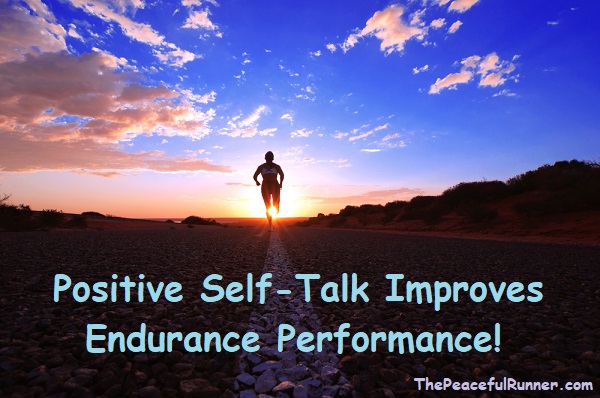
Research in sports psychology has shown that structured positive self-talk can improve endurance performance. In one study, cyclists who were trained to use positive self-talk were able to ride longer before fatigue set in—even though the physical effort felt the same. Researchers concluded that motivational self-talk improved endurance performance by significantly reducing RPE (Rate of Perceived Exertion).
For runners, this matters because fatigue is as much mental as it is physical.
Positive self-talk can help you:
- Stay calmer when effort increases
- Reframe discomfort as temporary
- Maintain focus late in a run or race
- Recover confidence after a difficult training day
In short, your mind becomes an ally instead of an obstacle.
Take Back Your Power on the Run!
There was a time when running felt like something I had to do—another obligation on an already long list. My inner dialogue reflected that pressure. Often I would say to myself, "I have to go running tomorrow morning." Instantly, I would feel the stress of this statement and a resistance to running.
Compare the following statements and how you feel as you say them: "I get to go running" versus "I have to go running." One feels exciting and empowering and the other feels self-defeating.
When I shifted my self-talk from “I have to run” to “I get to run”, something changed. The miles didn’t magically become easier, but they became lighter. The run turned into a choice rather than a chore.
That shift—subtle as it seems—gave me my power back.
This is not only an amateur runner's concern. Josh Kerr, who broke the mile world record in July 2026, says that strength is a mental thing as much as a physical one, and he trains his mind as deliberately as his legs: his training routine shows how that belief holds up at the highest level.
How to Practice Positive Self-Talk: 5 Simple Steps for Runners
You don’t need to overhaul your mindset overnight. Positive self-talk is built gradually, one thought at a time.
1. Notice Your Inner Dialogue
Start paying attention to what you tell yourself mid-run, especially when effort increases.
2. Catch the Negative Pattern
When you hear phrases like “I can’t do this”, pause. Simply noticing the thought weakens its grip.
3. Reframe, Don’t Deny
Replace criticism with something realistic and supportive:
- “This is hard, but I’m handling it.”
- "This is challenging and that's ok."
4. Repeat with Intention
Positive self-talk works through repetition. Choose a phrase and return to it when your mind wanders.
5. Practice Outside of Running
Use supportive language in daily life. The way you speak to yourself off the run shapes how you speak to yourself on it. By paying attention to your words, you can uncover thought patterns that may be quietly creating resistance or discomfort. Often, it’s these unnoticed thoughts that unintentionally drain our energy and affect our training. Our words reflect our thoughts—and ultimately, our attitude.

Positive Self-Talk Examples for Runners
Here are some simple phrases you can use during different running moments:
Just Before a Run or Race
- “I am choosing to run because it energizes me.”
- “Every run makes me stronger.”
During a Long Run
- “I’m steady and strong.”
- “One step at a time.”
When Fatigue Sets In
- “I’ve felt this before, and I kept going.”
- “This feeling will pass.”
On Hills or Hard Efforts
- “I’m capable of this.”
- “Strong body, calm mind.”
On Tough Mental Days
- “Showing up is enough today.”
- “This run counts, even if it’s imperfect.”
Choose phrases that feel natural to you. If they sound forced, adjust them until they feel believable.
Positive Self-Talk vs. Positive Affirmations
Positive self-talk is often confused with affirmations. While affirmations can be helpful, self-talk is more flexible and responsive to the moment.
Affirmations tend to be:
- Repeated intentionally
- More general
- Used before or after runs
Self-talk happens during the run, in real time, when it matters most.
You can absolutely use both—but think of self-talk as the steady voice that carries you through effort.
Try our positive affirmations for runners for reinforced mindset support.
Also, learn how you can become Your Own Cheerleader!
Common Questions About Positive Self-Talk for Runners
What if positive self-talk feels fake?
What if positive self-talk feels fake?
Start with neutral, supportive phrases rather than overly optimistic ones. Believability matters more than positivity.
Can self-talk really improve endurance?
Can self-talk really improve endurance?
Yes. While it doesn’t remove physical effort, it helps regulate perception of fatigue and keeps you mentally engaged.
How long does it take to notice a difference?
How long does it take to notice a difference?
Many runners notice subtle changes within a few weeks of consistent practice, especially during longer or harder runs.
Final Thoughts
Running will always involve moments of discomfort. Positive self-talk doesn’t remove that—but it changes how you move through it.
By learning to speak to yourself with patience, encouragement, and honesty, you create a more peaceful relationship with running—one where effort is met with compassion instead of resistance.
That’s where real strength begins.
Back to top of Positive Self-Talk
Return to Running Psychology
You might like these
Positive affirmations for runners
Positive affirmations can shift how you think, feel, and move—on and off the trail.
Visualization Techniques for Runners
Visualization techniques can help us achieve running goals, feel more confident and recovery from injuries.
How to change limiting beliefs about your body
How to change limiting beliefs about your body. What you believe about your body can have a dramatic effect on how you run and how often you get injured.
Tips for Running on Vacation
Running on vacation can be one of your most memorable holiday experiences and not as difficult as you may think. Get the best tips here!
Powerful Mantras for Running Help you Stay Strong and Motivated
Mantras for running are powerful! They can help you stay strong mentally and physically while running.
Stay Motivated For Running
Let's stay motivated for running. We know how powerful it is. A motivated runner knows no obstacles.









- Home
- Running Psychology
- Positive Self-talk for Runners
NEW FEATURE - DISQUS COMMENTS!
Login using Facebook, Twitter, Google or Disqus.
Want my writing to find you more easily?
Add The Peaceful Runner as a preferred source on Google

FTC Disclosure: As an Amazon Associate, I earn from qualifying purchases. Learn more



Recent Articles


-
My Back Healed, and It Changed How I Run
Sep 15, 26 02:07 PM

Why I recommend this online Feldenkrais running course to runners who keep getting hurt. -
Six Hot Runs in Protaras, and the Quiet Trail I Found
Aug 31, 26 12:35 PM

Running in Protaras in July heat. The busy boardwalk north, the quiet gravel trail south towards Green Bay, and how to stay present when it is hot. -
An Honest Note About Runners Trots, and What I Am Beginning to Suspect
Aug 05, 26 10:22 AM

A personal story from a Saturday morning parkrun, and what I am beginning to suspect about the connection between fear, tension, and cramping. -
Josh Kerr's Training Routine: The Foundations of a Mile World Record
Jul 20, 26 06:04 AM

Josh Kerr just broke the mile world record. He ran 3:42.66 in London Saturday, taking down a mark that stood for 27 years. -
Introducing The Peaceful Runner Method Workbook
Jul 08, 26 06:01 AM

Announcing The Peaceful Runner Method Workbook, a mind-body guide for runners who keep getting hurt. Learn eleven simple practices for running injury-free. -
How to Listen to Your Body When Running
Jun 20, 26 09:44 AM

A true story about a stubborn ache and what listening to my body taught me. -
How To Prevent Running Injuries - 7 Lessons
Jun 05, 26 12:50 PM

Seven things I have learned about running injuries that most runners are never told. -
Why More Runners Are Switching to Toe Socks
May 04, 26 02:04 PM

Toe socks might look a little unusual at first, but more and more runners are making the switch. They can make a meaningful difference to your running comfort and performance. -
What Heel Strikers Should Know
Apr 10, 26 01:34 PM

If you’ve ever wondered whether your stride is helping or holding you back, this will give you clarity. -
Excellent Design and Craftsmanship: #PRPocket Review
Mar 09, 26 10:49 AM




Free Running Form Template
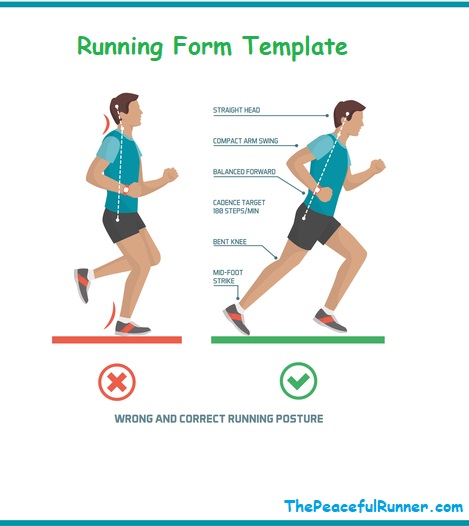
Get the running form template now!
My template provides a straightforward explanation of the components of good running form, eliminating any confusion about how to improve your running technique.
Hate bulky phone holders
that bounce and slip?

The #PRPocket clips securely to the inside of your waistband.


Try our Guided Running Meditation to become a peaceful, happy and injury free runner.